A recruiter sits in front of two applications.
Both candidates graduated from reputable institutions. Both earned similar grades. Both lists communication, leadership, critical thinking, and problem-solving among their strengths.
Yet one question remains unanswered:
Who can actually perform the job?
For decades, education and employment have operated in parallel. Schools and universities focused on delivering knowledge and awarding credentials, while employers developed their own methods to evaluate talent. The result was often a disconnect between what learners achieved academically and what organizations needed in the workplace.
Today, that divide is beginning to disappear.
As artificial intelligence reshapes industries and job roles evolve faster than ever, organizations are placing greater value on demonstrable skills rather than credentials alone. At the same time, educational institutions are seeking better ways to measure real-world competencies and career readiness.
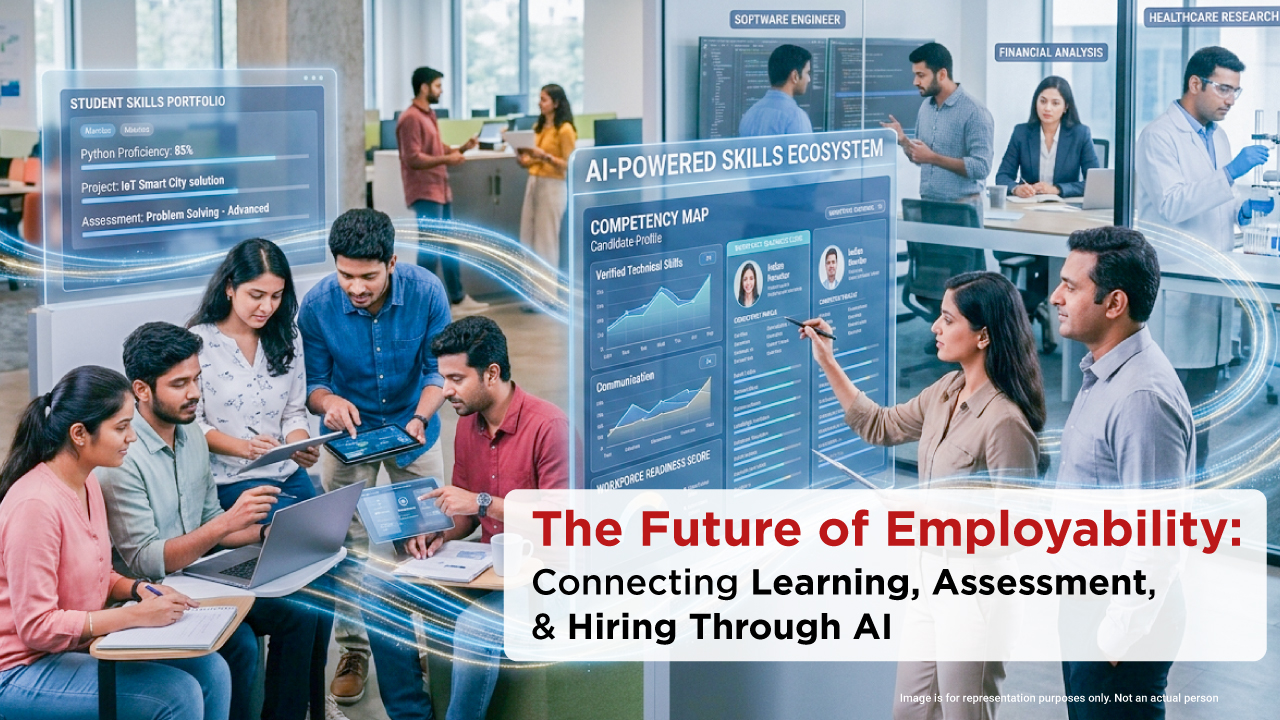
The result is a new era in which learning, assessment, and hiring are part of a connected ecosystem powered by real-time skill verification.
Why Degrees Alone Are No Longer Enough in the AI Economy
For generations, degrees served as the primary signal of capability. Employers used academic qualifications as a convenient way to identify talent and reduce hiring risk.
However, the modern workplace demands far more than subject knowledge.
Organizations increasingly seek professionals who can:
-
Solve complex problems
-
Adapt to changing environments.
-
Collaborate across teams
-
Communicate effectively
-
Learn new technologies quickly.
-
Apply knowledge in practical situations.
A degree may indicate exposure to learning, but it does not always prove workplace readiness. As a result, employers are looking beyond credentials and focusing on validated competencies.
The Rise of Skills-Based Hiring & Talent Evaluation
The AI economy is accelerating the shift toward skills-first recruitment.
Rather than relying solely on resumes, employers are incorporating:
-
Skills assessments
-
Scenario-based evaluations
-
Project portfolios
-
Simulation exercises
-
Competency mapping
-
Continuous workforce assessments
This approach provides a clearer picture of a candidate's ability to perform in real-world situations.
Skills-based hiring also helps organizations discover talent that traditional qualification-based screening may overlook, creating increasingly inclusive and effective recruitment practices.
How AI Enables Real-Time Skill Verification
AI is transforming how skills are measured and validated.
Modern assessment platforms can analyze performance across multiple activities and provide a greater understanding of competency development.
AI-powered systems can:
* Track learning progression
Determine strengths and skill deficiencies
* Measure problem-solving approaches
* Evaluate decision-making patterns
* Personalize assessment pathways
* Proactively predict the workforce to arrive at the correct workforce strategy
Organizations can not only conduct a single examination or interview, but also continuously evaluate capability using multiple data points collected over time.
Bridging the Gap Between Education & Workforce Readiness
The biggest hurdle in education is preparing students for the realities of the job market.
There's a gap between what employers expect and what students do in the classroom. Schools, on the other hand, are looking for more efficient methods to show the effectiveness of their programs.
Real-time assessment provides a connection between these two worlds.
Measuring competencies valued by the workforce can help institutions ensure that learning outcomes correspond to the needs of the labor market. Students become better informed about their strengths and growth areas, and employers can be confident of future talent.
Why Educational Institutions Are Embracing Competency-Based Assessment
A conventional resume documents an individual's experiences.
These will be strengthened in future talent profiles.
Digital skill profiles may be comprised of:
* Verified competencies
* Assessment outcomes
* Project achievements
* Industry certifications
* Collaboration indicators
* Continuous learning milestones
These dynamic records grow with people as they go through their careers, giving employers a more complete view than a static resume or transcript.
Digital Skill Profiles Are Becoming the New Professional Resume
The traditional resume captures a snapshot of a person's experiences.
Future talent profiles will provide something much more powerful.
Digital skill profiles can include:
-
Verified competencies
-
Assessment outcomes
-
Project achievements
-
Industry certifications
-
Collaboration indicators
-
Continuous learning milestones
These dynamic records evolve alongside individuals throughout their careers, providing employers with richer insights than static resumes or transcripts alone.
How Employers Are Using Continuous Assessment to Build Stronger Workforces
Forward-thinking schools, colleges, and universities are moving toward assessment models that focus on demonstrable outcomes rather than memorization.
Continuous skill evaluation is being adopted by organizations more and more, and it is being utilized to assist in:
* Internal mobility
* Leadership development
* Workforce planning
* Upskilling initiatives
* Career progression pathways
* Talent retention strategies
Real-time workforce capability information can enable businesses to make better decisions regarding hiring, training, and growth.
The Future of Talent Intelligence & Lifelong Learning
The future of employability will not be defined by a single degree or certification.
Instead, individuals will continuously build, validate, and showcase new skills throughout their careers.
Learning will become more personalized.
Assessment will become more continuous.
Career progression will become more evidence-based.
The organizations that thrive will be those that can accurately identify, develop, and deploy talent based on verified capabilities rather than assumptions.
How VMI India Enables Real-Time Skill Assessment & Workforce Readiness
As education and employment continue to converge, institutions and organizations require assessment systems that provide meaningful insights into learners' and the workforce's capabilities.
VMI India helps educational institutions, training providers, and employers implement AI-powered assessment frameworks that measure real-world skills and workforce readiness.
Through intelligent assessment solutions, VMI India enables organizations to:
-
Validate practical and job-ready competencies.
-
Create adaptive assessment experiences.
-
Track skill development continuously
-
Build comprehensive learner and talent profiles.
-
Align educational outcomes with employer expectations.
-
Generate actionable workforce intelligence.
By connecting learning outcomes with industry requirements, VMI India helps create a future where skills are visible, measurable, and trusted across the entire talent ecosystem.
Conclusion: Skills Are Becoming the New Talent Currency
The relationship between education and employment is undergoing a fundamental transformation.
In the AI economy, success will increasingly depend on what individuals can demonstrate rather than on their credentials.
As real-time assessment, skills verification, and intelligent talent insights become more widespread, education and hiring will no longer operate as separate systems.
They will become part of a connected ecosystem focused on one goal: identifying, developing, and rewarding human potential.
In this new world, skills are not just important.
They are the new currency of opportunity.